Blade vs. Mallet Putter: Which One Is Right for Your Game?
Walking into a golf shop can feel overwhelming. You’re faced with a sea of putters, all promising to be the magic wand that finally ends your three-putt nightmares. The biggest choice you’ll face is between two distinct families: the classic, sleek blade putter and the modern, oversized mallet putter.
Choosing the right one isn’t just about looks; it’s about matching the technology to your unique putting stroke. Get it right, and you’ll find a level of consistency on the greens you didn’t think was possible. Get it wrong, and you’ll be fighting your equipment on every putt.
In my years of playing and coaching, I’ve seen firsthand how a simple putter change can transform a golfer’s confidence. In this guide, we’ll break down everything you need to know about the difference between a blade and a mallet putter, helping you make the perfect choice for your game.
Key Takeaways: Blade vs. Mallet at a Glance
- Blade Putters are best for players with an “arcing” putting stroke. They offer superior feel and feedback but are less forgiving on off-center hits.
- Mallet Putters are ideal for players with a “straight back, straight through” stroke. They provide maximum forgiveness, stability, and often have better alignment aids.
- The Main Difference lies in the head shape and weight distribution, which influences how the putter performs during your stroke.
- Your Stroke Type (arc vs. straight) is the most important factor in deciding which style is best for you.
What is the Difference Between a Blade and Mallet Putter? The Core Concepts
At its heart, the difference between these two putter types comes down to physics—specifically, head design and Moment of Inertia (MOI).
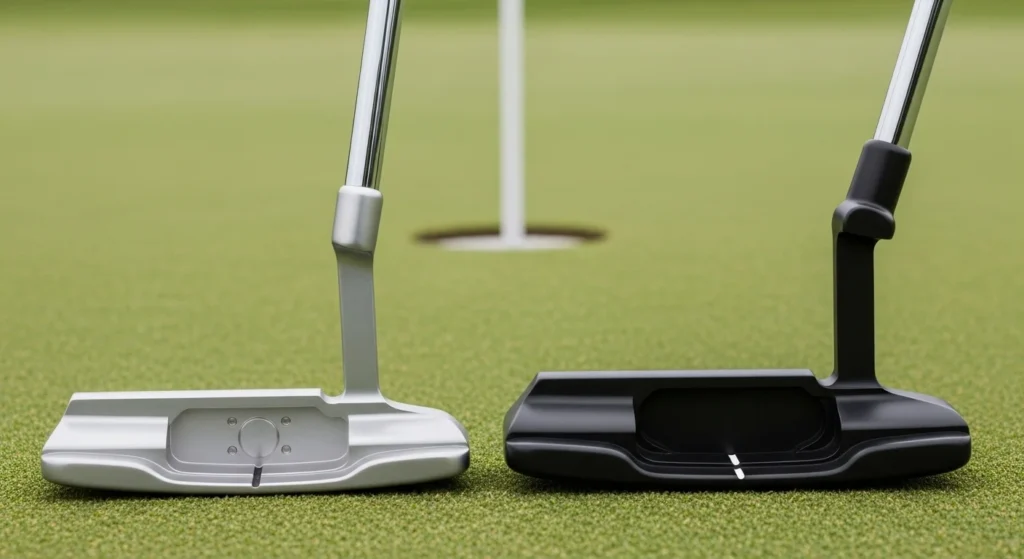
A blade putter has a traditional, simple, and narrow head shape. Think of the classic PING Anser or Scotty Cameron Newport. The weight is distributed more evenly across the head.
A mallet putter, on the other hand, features a large, semi-circular, or square clubhead. This design allows engineers to push weight to the perimeter of the clubhead, far away from the face. This dramatically increases the MOI, which is just a technical way of saying it’s more resistant to twisting on off-center hits. A higher MOI means more forgiveness.
The Blade Putter: A Deep Dive into Feel and Precision
The blade putter is the traditionalist’s choice. For decades, it was the only style you’d see, and it’s still trusted by some of the best players in the world for its unmatched feedback and control.
Design and Characteristics
Blades are known for their elegant, minimalist look. The smaller head size gives players a strong sense of connection with the ball at impact. This direct feedback is what skilled golfers crave—you instantly know if you struck the putt purely or not.
This design typically features significant toe hang. If you balance the shaft on your finger, the “toe” (the end of the putter head) will hang down, pointing towards the ground. The amount of toe hang varies, but it’s a key feature designed for a specific type of stroke.
Who Should Use a Blade Putter? (The “Arc” Stroke Golfer)
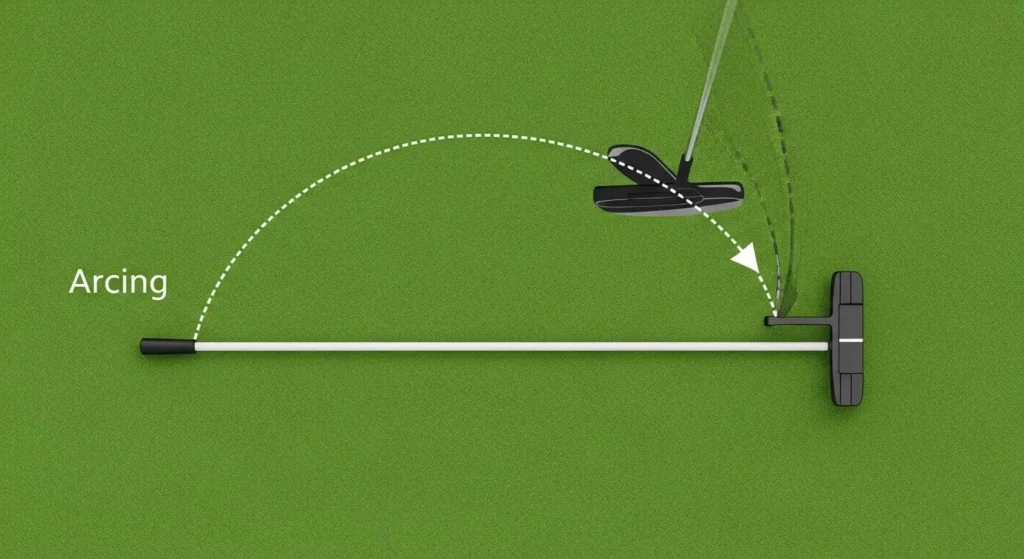
A blade putter is built for a golfer with an arcing putting stroke. This means the putter head travels on a slight curve during the stroke—opening on the backswing, squaring at impact, and closing on the follow-through. It’s the most common type of stroke among golfers.
The toe-hang design helps the putter face naturally rotate open and closed, perfectly complementing the arc. In my experience, trying to use a blade with a straight-back-and-through stroke feels like a constant fight to keep the face square.
Pros and Cons of Blade Putters
Pros:
- Superior Feel & Feedback: Allows for exceptional distance control once mastered.
- Better for Fast Greens: The direct feedback helps prevent hitting putts too hard on slick surfaces.
- Classic Aesthetics: Many golfers simply prefer the traditional look at address.
Cons:
- Less Forgiving: Mis-hits off the heel or toe will lose more distance and direction compared to a mallet.
- Requires Consistency: Demands a more precise and repeatable putting stroke to see good results.
The Mallet Putter: Your Ally for Forgiveness and Stability
If blade putters are sports cars, mallet putters are luxury SUVs. They are modern, packed with technology, and engineered to make putting as easy as possible, especially for the amateur golfer.
Design and Characteristics
Mallets come in all shapes and sizes, from semi-circles to fang-like designs (like the popular Odyssey #7). Their defining feature is a large, deep clubhead. This size allows for complex weighting schemes that maximize stability and forgiveness.
Most mallets are face-balanced. When you perform the same balance test, the face of the putter will point straight up to the sky. This design is engineered to resist rotation, making it easier to keep the putter face square throughout the stroke. Furthermore, mallets often feature elaborate lines and shapes that act as powerful alignment aids.
Who Should Use a Mallet Putter? (The “Straight Back, Straight Through” Golfer)
A mallet putter is perfect for a golfer who aims for a “straight back, straight through” putting stroke. The idea is to move the putter like a pendulum, with no rotation of the clubface.
The face-balanced design of a mallet minimizes the natural tendency for the face to open or close, making it much easier to execute this type of stroke. If you’re a player who struggles with pushing or pulling putts, the stability of a mallet can be a game-changer. For a beginner, this is often the putter I recommend starting with as it simplifies one of the hardest parts of putting.
Pros and Cons of Mallet Putters
Pros:
- Maximum Forgiveness: The high MOI ensures even your mis-hits roll out closer to your intended target.
- Enhanced Alignment: The larger size and visual aids make it much easier to aim correctly.
- Incredible Stability: The balanced design helps smooth out a shaky or inconsistent stroke.
Cons:
- Less Feedback: The forgiving nature can sometimes make it harder to judge distance, especially on long putts.
- Bulky Appearance: Some golfers find the large head distracting or clunky.
Blade vs. Mallet Putter: Head-to-Head Comparison
| Feature | Blade Putter | Mallet Putter |
|---|---|---|
| Best For | Players with an arcing stroke | Players with a straight stroke |
| Forgiveness | Low | High |
| Feel/Feedback | Excellent | Good / Muted |
| Alignment | Basic (usually a single line) | Excellent (multiple lines/shapes) |
| Design | Traditional, compact head | Modern, large head |
| Typical User | Lower handicaps, purists | All skill levels, especially high handicappers |
How to Choose the Right Putter for YOU
Okay, the theory is great, but how do you apply it? Here’s a simple, step-by-step process I use to help my students find their perfect match.
Step 1: Identify Your Putting Stroke
This is the most critical step. Find a yardstick or two alignment sticks and place them on the floor. Without a ball, make your natural putting stroke, trying to keep the putter head moving along the line.
- Did the toe of your putter swing inside the line on the backswing? You have an arc stroke. You should start by testing blade putters and mallets with some toe hang.
- Did your putter face stay perfectly square to the line all the way back and through? You have a straight stroke. A face-balanced mallet is your ideal starting point.
Step 2: Consider Your Common Misses
Think about your last few rounds. When you miss a putt, why does it happen?
- If you struggle with distance control (leaving putts way short or blasting them past the hole), the enhanced feel of a blade might help you dial in your speed.
- If you struggle with starting the ball on the right line (pushing or pulling putts), the stability and alignment aids of a mallet could be transformative. This is especially true if you are just learning How to Read Greens like a pro
Step 3: Go Get Fitted (The Pro Tip)
I cannot stress this enough: the single best thing you can do for your putting is to get a professional fitting. A fitter will use high-tech launch monitors to analyze your stroke and find the perfect putter specs for you—from head type to length, lie angle, and grip. It’s an investment that pays for itself in saved strokes. For more on this, major brands like PING have excellent resources explaining the process.
For those looking to make a choice at home, a mallet like the TaylorMade Spider Tour is a fantastic and incredibly popular option for its forgiveness. For players wanting that classic blade feel, you can’t go wrong with a model like the Scotty Cameron Newport 2, which has been trusted by pros for decades.
Frequently Asked Questions (FAQ)
For the average golfer, yes. Blade putters have a smaller sweet spot and are less forgiving than mallets. They require a more consistent, repeatable stroke to perform well.
It’s a mix, but there has been a significant shift towards mallets on professional tours in the last decade. While legends like Tiger Woods are famous for using a blade, many top players now opt for the extra stability and forgiveness a mallet provides.
Overwhelmingly, yes. In my experience, the forgiveness, stability, and alignment help offered by a mallet putter provides a much bigger benefit to beginners and high handicappers who are still developing a consistent stroke.
Use the balance test! Lay the shaft of the putter across your open palm or finger. If the face points upwards to the sky, it’s face-balanced. If the toe of the putter hangs down towards the ground, it has toe hang.
The Final Verdict: Confidence Is Key
Ultimately, the debate between blade and mallet putters isn’t about which one is “better”—it’s about which one is better for you.
The perfect putter is a blend of technology that matches your stroke and a look that inspires confidence when you stand over the ball. Use this guide to identify your stroke type and narrow down your options. But once you have, the final test is to trust your gut. Find the one that feels like an extension of your arms and makes you feel like you can’t miss.
Once you have the right wand in your hands, Choosing the Right Putter Grip will complete the package and give you total control.
What type of putter are you using right now? Let us know in the comments below if you’re thinking of making a switch after reading this guide!