
Sink More Putts: How to Find the Proper Putting Grip to Keep Your Hands Steady
We’ve all been there. You’ve hit a perfect drive, a crisp iron shot, and a tidy chip to leave yourself a five-footer for par. And then, standing over the ball, your hands start to feel twitchy, the putter feels heavy, and the smooth stroke you had on the practice green completely disappears. The result? A frustrating miss that ruins an otherwise great hole.
If that sounds familiar, you’re not alone. Unsteady hands are one of the most common and costly problems in amateur golf. But what I’ve found after years on the course is that the solution almost always starts with your connection to the club: your grip.
Finding the proper putting grip to keep your hands steady is the single fastest way to build confidence, create a repeatable stroke, and finally start making those putts that matter. In this guide, we’ll break down everything you need to know to find a stable, comfortable, and effective putting grip.
Quick Guide: Key Takeaways for a Steady Putting Grip
For those who want the quick version, here are the core principles we’ll cover:
- Light Grip Pressure is Crucial: Your hands are for holding the putter, not strangling it. Think of a 3-4 out of 10 pressure level.
- Your Grip Should Quiet Your Hands: The goal of any putting grip is to minimize unwanted wrist and hand movement, allowing the larger muscles in your shoulders and back to control the stroke.
- There is No “One-Size-Fits-All” Grip: From Reverse Overlap to the Claw, there are multiple tour-proven grips. The “best” one is the one that works for your stroke.
- A Solid Setup is the Foundation: A steady grip won’t work without proper posture and alignment. Your arms and shoulders should form a stable triangle.
Why a Rock-Solid Putting Grip is Non-Negotiable
Before we dive into the “how,” let’s talk about the “why.” Your hands are full of small, fast-twitch muscles that are fantastic for generating speed in a full swing but are disastrous for the delicate feel required in putting. When these muscles get overactive, they cause the dreaded “yips” or that shaky feeling where you lose all control.
A proper putting grip effectively “locks” your hands and wrists into a more passive role. This forces you to engage the large, slow-twitch muscles of your shoulders, back, and core to create a smooth, pendulum-like motion. In my experience, the moment a golfer masters this, their consistency on the greens improves tenfold.
A steady putting stroke gives you:
- Better Distance Control: A pendulum stroke is repeatable, making it easier to gauge the pace of your putts.
- Improved Accuracy: It ensures the putter face stays square to your target line through impact.
- More Confidence: A stable grip eliminates the fear of a twitchy stroke, freeing you up to focus on reading the green.
The Foundation: Mastering Grip Pressure and Hand Position
Before you experiment with different styles, you need to master the fundamentals of holding a putter. If you get these two things right, you’re already 80% of the way to a steadier stroke.
Find the Perfect Grip Pressure
This is the most important putting tip I can give. Most amateurs grip the putter far too tightly, which creates tension all the way up their arms and into their shoulders. This tension is the primary cause of a jerky, uncontrolled stroke.
Pro Tip: On a scale of 1 to 10, where 1 is barely holding on and 10 is a white-knuckle death grip, your putting grip pressure should be a 3 or 4. You should feel like the putter is secure, but your hands, wrists, and forearms are completely relaxed. The goal is to hold it just tight enough so it doesn’t slip out of your hands.
2. Set Your Hand Position
For a standard grip, start with your lead hand (left hand for a right-handed player). Place the grip diagonally across your palm so it rests in the “lifeline” of your hand. This helps it feel like an extension of your arm.
Next, add your trail hand (right hand) in a similar position. The palms should either be facing each other (neutral) or with the trail hand’s palm slightly more toward the target. This simple setup promotes a unified movement, preventing one hand from dominating the other.
Finding Your Proper Putting Grip to Keep Your Hands Steady
Now for the fun part: experimenting to find the grip style that quiets your hands the most. I recommend heading to a practice green and spending 10-15 minutes with each of these popular styles to see what feels most natural and produces the best results.
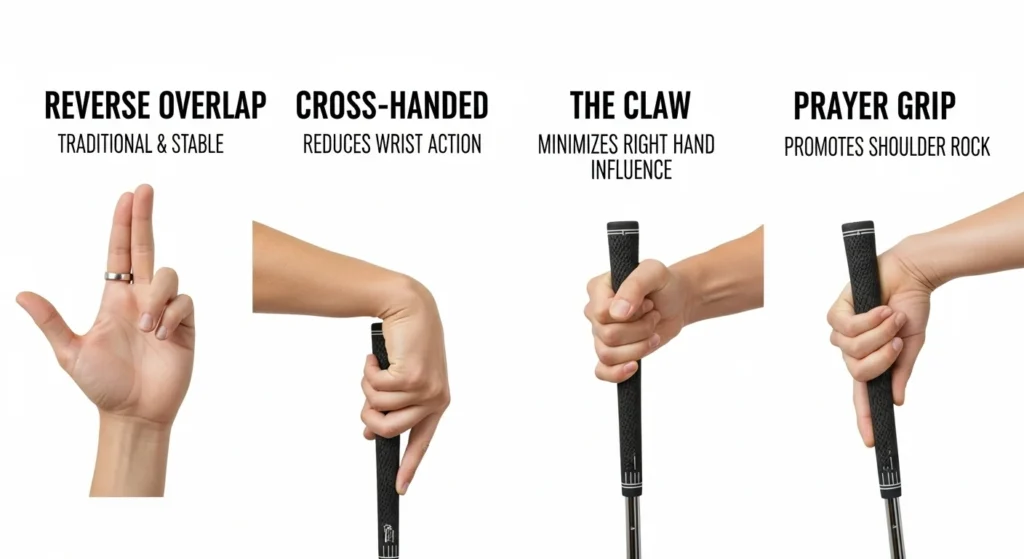
The Reverse Overlap Grip (The Timeless Classic)
This is the most common putting grip in golf for a reason. It’s used by legends like Tiger Woods and Jack Nicklaus.
- How to do it: Take your standard ten-finger golf grip. Then, lift the index finger of your lead (left) hand and rest it on top of the fingers of your trail (right) hand.
- Why it works: This simple overlap unifies the hands, making them work as a single unit. It provides a great balance of feel and stability.
- Who it’s for: This is a fantastic starting point for any golfer. It’s particularly good for players who want to maintain some feel in their hands without them becoming too active.
The Cross-Handed Grip (Lead Hand Low)
If you have exceptionally twitchy hands, this could be the game-changer you need. Jordan Spieth has used this grip to become one of the best putters in the world.
- How to do it: Simply reverse your hand positions. Your lead (left) hand goes below your trail (right) hand on the grip.
- Why it works: Placing your lead hand lower levels out your shoulders, which is crucial for creating a pure pendulum stroke. More importantly, it almost completely restricts the dominant trail hand from “hitting” at the ball, which is a major cause of pulls and pushes. What I’ve found works best is to really feel your left hand guiding the putter face through the ball.
- Who it’s for: Golfers who struggle with the yips or who feel their dominant hand is too involved in their stroke.
The Claw Grip (And Its Variations)
The claw has surged in popularity on professional tours. It’s a bit unconventional, but it’s one of the best for truly taking your hands out of the equation.
- How to do it: Your lead (left) hand takes its normal position at the top of the grip. Your trail (right) hand is positioned differently: the grip rests between your thumb and index finger, and your palm faces your body. The other fingers rest lightly on the side of the grip.
- Why it works: This grip turns your right hand into a stabilizing force rather than a power source. It makes it nearly impossible to flip your wrists at the ball.
- Who it’s for: Players who have tried everything else and still can’t stop their right hand from being overactive.
Drills for an Unshakeable Putting Stroke
Once you’ve settled on a grip, you need to ingrain it with practice. These simple drills will build muscle memory and give you instant feedback.
- The Right-Hand-Only Drill: Place your left hand on your thigh and hit 10-foot putts using only your right arm. This forces you to feel the natural pendulum motion driven by your shoulder.
- The Gate Drill: Place two tees on the ground just wide enough for your putter head to pass through. This will train you to deliver the putter face squarely at impact, a direct result of a stable grip.
- The Forearm Squeeze: Place a golf glove or a small, soft ball between your forearms. Make your putting stroke without dropping it. This drill ensures your arms are working together and prevents any independent, shaky movements.
Helpful Tools for a Steadier Stroke
While technique is paramount, some modern equipment can make it much easier to achieve a steady putting grip.
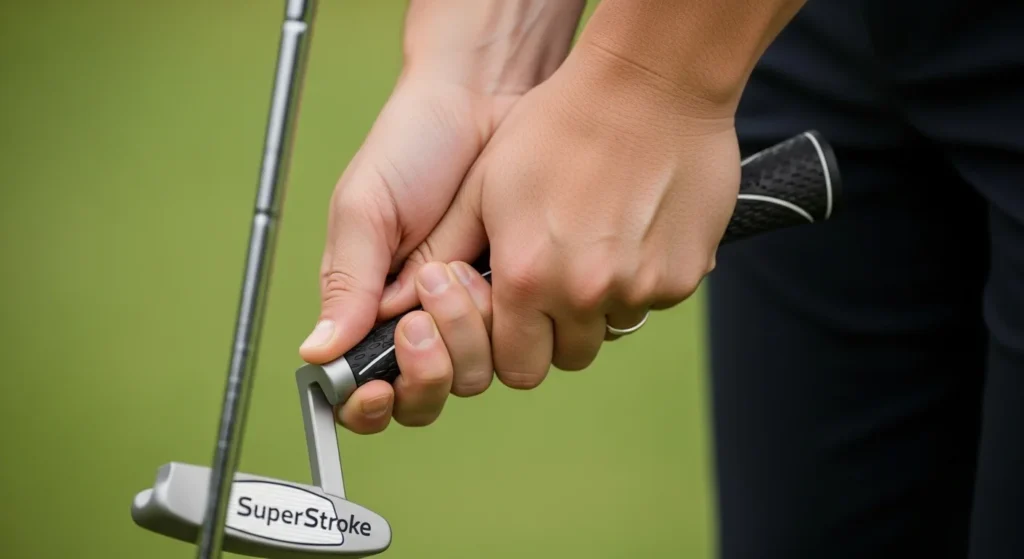
For instance, many golfers find success with an oversized putter grip, like the popular SuperStroke Traxion Tour Putter Grip. The larger diameter fills your hands more completely and reduces the ability of your wrist muscles to hinge. It’s not a magic fix, but it can provide a significant advantage in quieting your hands.
A steady grip is most effective when combined with a consistent setup and stroke path. After you’ve settled on a grip, practicing with a tool like the Perfect Practice Putting Mat can help you ingrain that muscle memory at home.
The science behind grip is fascinating. To maintain a steady stroke, you need precise motor control, which is heavily influenced by grip pressure. Research highlighted by the National Institutes of Health has shown that optimal grip force is critical for performance in putting.
A stable grip is just one piece of the puzzle. Once you’ve got it locked in, you’ll need to make sure your equipment is right for you. Check out our Guide on How to Choose the Perfect Putter Length and Style. And of course, a great stroke won’t help if you’re aiming at the wrong line, so be sure to read our Beginner’s Guide to Reading Greens.
Frequently Asked Questions (FAQ)
You should grip the putter very lightly. On a scale of 1-10, aim for a pressure of 3 or 4. Your goal is to be relaxed, not tense. Too much pressure is the number one cause of shaky hands.
Yes, indirectly. A putter that is too long, too short, or has an improper lie angle can force you into an uncomfortable setup. This discomfort can lead to tension and an unsteady stroke. Getting fitted for a putter is always a good idea.
The Reverse Overlap is still the most common grip among professionals due to its excellent blend of feel and stability. However, the Cross-Handed (Lead Hand Low) and various forms of the Claw grip have become extremely popular as players seek ways to quiet their hands.
The best way is to feel that your arms, shoulders, and hands form a solid triangle. During the stroke, this triangle should rock back and forth from your shoulders without any independent wrist hinge. The Cross-Handed and Claw grips are specifically designed to help prevent this wrist breakdown.
Sinking More Putts: Finalizing Your Steady Putting Grip
Finding the proper putting grip to keep your hands steady isn’t about finding a “secret” hold; it’s about finding a systematic way to remove the small, twitchy muscles from your stroke. Start with a light grip pressure, experiment with the styles that feel most natural, and commit to the one that gives you the most confidence.
A steady putting stroke is a reliable putting stroke, and that’s the key to lowering your scores and having more fun on the course.
What putting grip has worked best for you? Have you tried the claw or cross-handed style? Share your experience in the comments below!