

Understanding the Basic Scoring Terms in Golf (Par, Bogey)
Stepping onto a golf course for the first time is exciting, but hearing players talk about “pars,” “bogeys,” and “birdies” can feel like learning a new language. It can be intimidating and take some of the fun out of the game when you’re just trying to hit the ball.
In my experience, once you grasp a few basic concepts, golf scoring is actually pretty simple. The goal of this guide is to break down everything you need to know in plain English. We’ll turn that confusing scorecard into a simple tool that helps you track your progress and enjoy your round.
Key Takeaways: Golf Scoring at a Glance
For those in a hurry, here are the absolute basics of golf scoring terms:
- Par: The target score for a hole, representing the number of strokes an expert golfer should take to finish. All other scores are compared to par.
- Birdie: A great score of one stroke under par on a hole (e.g., scoring a 3 on a Par 4).
- Bogey: A very common score of one stroke over par on a hole (e.g., scoring a 5 on a Par 4). This is a frequent score for most amateur golfers.
- Double Bogey: A score of two strokes over par on a hole. Don’t worry if you get these; they are a normal part of learning the game.
- Eagle: An excellent and rare score of two strokes under par on a hole, most often achieved on a Par 5.
What is Par? The Foundation of All Golf Scoring
Before we can understand the other terms, we have to talk about par. Think of par as the official target score for each individual hole. Every hole on a golf course is assigned a “par” number, which represents the number of strokes an expert golfer is expected to take to get the ball from the tee into the hole.
A hole’s par is determined primarily by its length, and while it can vary, the United States Golf Association (USGA provides guidelines. The “expected strokes” are also broken down into specific types of shots:
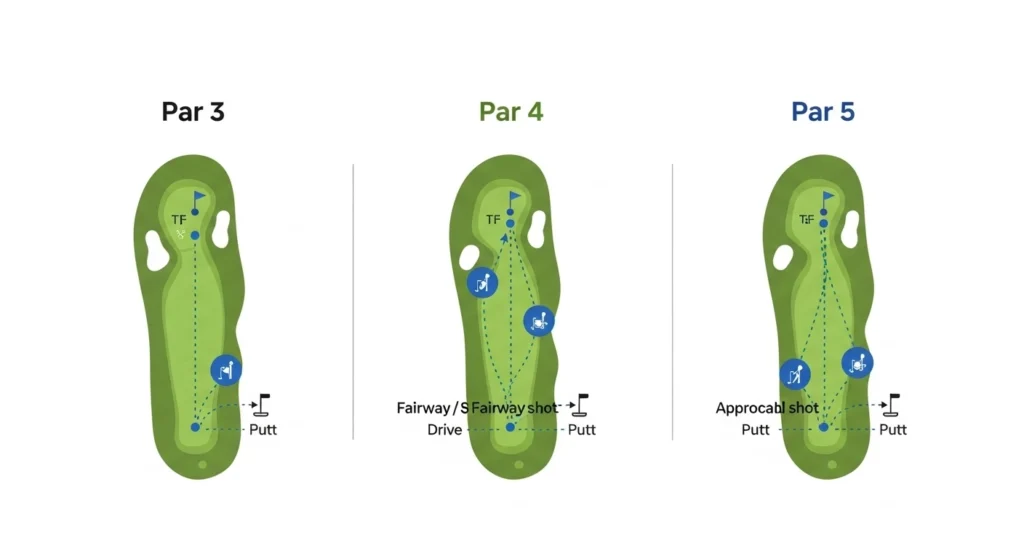
- Par 3: These are the shortest holes. According to USGA guidelines, they are typically up to 260 yards for men and up to 220 yards for women. The expectation is 1 shot to land on the green (the tee shot) and then 2 putts to get the ball in the hole. (1 Tee Shot + 2 Putts = 3 strokes).
- Par 4: These are medium-length holes, generally 240 to 490 yards for men and 200 to 420 yards for women. An expert golfer is expected to hit the green in two shots (a drive from the tee, then an approach shot) and then take two putts. (1 Drive + 1 Approach Shot + 2 Putts = 4 strokes).
- Par 5: These are the longest holes, often 450 to 710 yards for men and 370 to 600 yards for women. The goal here is to reach the green in three shots (a drive, a second shot down the fairway, and an approach shot) and then take two putts. (1 Drive + 2 Other Shots + 2 Putts = 5 strokes).
So, if you are playing a Par 4 hole and you get the ball in the hole in exactly 4 strokes, you’ve made a par. Simple as that!
Understanding the Basic Scoring Terms in Golf: From Birdies to Bogeys
Now that you understand par, the rest of the terms are easy because they are all relative to par. Your score on a hole is simply how you did compared to that target score.
Scores Better Than Par (What You Strive For!)
- Birdie: This is when you finish a hole in one stroke less than par. For example, getting a 3 on a Par 4 is a birdie. It’s a fantastic feeling and a cause for a little celebration!
- Eagle: Even better than a birdie! An eagle is when you finish a hole in two strokes less than par. This is quite rare and usually happens on a Par 5 (getting a 3) or by holing out your second shot on a Par 4.
- Albatross (or Double Eagle): The rarest score in golf. This is when you take three strokes less than par, like getting a 2 on a Par 5. Many lifelong golfers never get one!
Scores Worse Than Par (Don’t Worry, It Happens!)
- Bogey: This is when you finish a hole in one stroke more than par. Getting a 5 on a Par 4 is a bogey. What I’ve found works best for new players is to not get discouraged by a bogey; they are a very common part of the game for golfers at all skill levels.
- Double Bogey: As the name suggests, this is two strokes more than par (a 6 on a Par 4).
- Triple Bogey: You guessed it—three strokes more than par (a 7 on a Par 4).
From here, you just keep counting (quadruple bogey, etc.), but many social players use a concept called “maximum score” to keep the game moving.
How to Keep Your Score on the Course
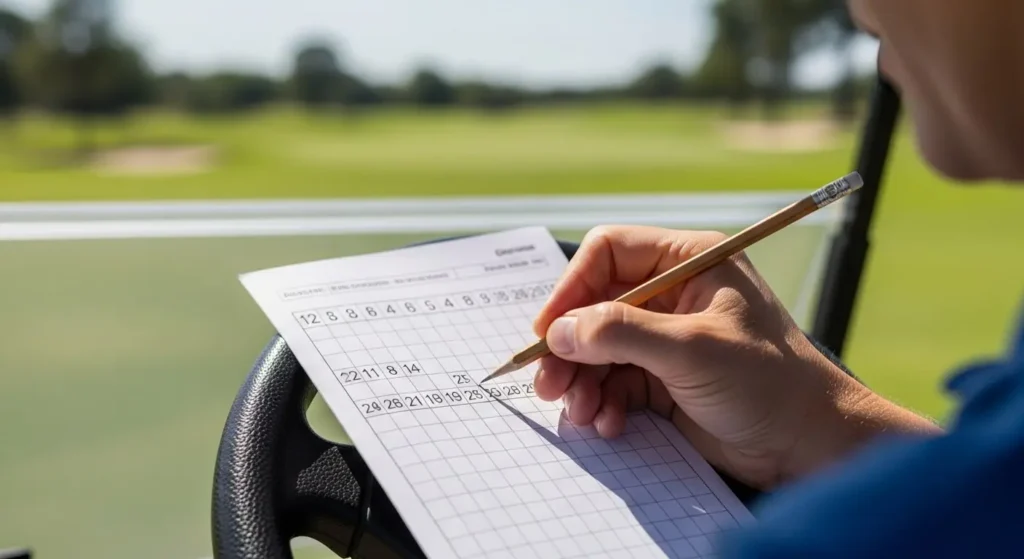
Keeping score is as simple as making a tally mark for every time you swing at the ball. At the end of the hole, you count up your strokes and write the total number in the box for that hole on your scorecard.
Here’s a pro tip for beginners: Don’t worry too much about your total score when you’re just starting. Instead, focus on the experience of hitting the ball and learning the rules. For a more detailed walkthrough on managing your game, check out our A Beginner’s Guide to Golf Etiquette.
To make things even easier, many players use accessories to help them. Here are a couple of things I’ve found incredibly useful:
- A Simple Stroke Counter: When you’re just starting, it’s easy to lose track of your shots. A simple, bead-style golf stroke counter that clips to your bag can be a lifesaver and lets you focus on your swing, not complex math.
- A Durable Scorecard Holder: Your scorecard can get beat up easily. A quality leather scorecard holder not only protects your card from sweat and rain but also makes you feel a bit more like a pro.
- A Golf GPS Watch (For Later): While not essential for your first day, as you play more, a golf GPS watch is a game-changer. It tracks your score automatically and gives you distances to the green, which is incredibly helpful.
Frequently Asked Questions (FAQ)
For a beginner playing a full 18 holes, any score below 120 is considered a very good start. A more realistic goal for your first few rounds is to shoot between 120 and 130. Don’t focus on the total score—celebrate the good shots!
Not at all, especially for amateur players. The average handicap for a male golfer in the United States is around 14, which means they average 14 bogeys (or worse) in a round. For new players, making a bogey is a perfectly respectable score on a difficult hole.
“Even par” means your total score is exactly equal to the combined par for the holes you’ve played. For example, if you make a bogey on the first hole (+1) and a birdie on the second hole (-1), your total score is back to “even par.”
A handicap is a numerical measure of a golfer’s potential ability, designed to allow players of different skill levels to compete against each other. In very simple terms, your handicap is roughly the number of strokes over par you are expected to shoot on average. The official rules for handicapping are maintained by organizations like the USGA (United States Golf Association), which is a great resource for more detailed information.
Final Thoughts: It’s All About Having Fun
Understanding the language of golf scoring is the first step to feeling more comfortable and confident on the course. Remember that par is your target, scores like birdies are a bonus, and bogeys are just part of the game.
The most important thing I’ve learned over the years is that golf is a journey of personal improvement. Your real competition is with yourself, not the other players. Now that you know the lingo, you’re ready to get out there and enjoy the game. For more tips on getting started, see our guide on How to Choose your first set of golf Club
What was the most confusing golf term for you when you started? Share your experience in the comments below!